
¶ Overview
The Defend-O-Tron is a transparent inline security appliance for small and medium businesses: the ones that need serious protection, but can’t justify the budget, the staff or the multi-year subscriptions of enterprise vendors like Cisco, Fortinet, Sophos or Palo Alto.
It sits between your ISP equipment and your router or firewall, and watches the traffic in both directions. Addresses that are known to attack are blocked before they reach your network. When the device detects a new attack, it bans the attacker. Scanners that try ports nothing should answer on are caught by its honeypot and banned too. The device has no address on your internet link, so nobody on the internet can see it or connect to it.
The Defend-O-Tron’s defense engine is CrowdSec and its firewall bouncer, with Suricata inspecting the traffic coming in from the internet (ISP → you) and going out to it (you → internet).
The Defend-O-Tron also takes part in the CrowdSec community. It reports the attackers it bans, and downloads the community blocklist every 2 hours. When enough reports about an address agree, CrowdSec adds it to that list, so an attacker caught somewhere else can already be blocked on your device before it reaches you. See The CrowdSec Community for exactly what a report contains.
Read more about our open source commitment: Open Source Matters.
¶ What’s Actually Happening Out There
The numbers below come from Verizon’s 2026 Data Breach Investigations Report (DBIR), one of the most widely cited yearly breach studies. This edition looks at more than 31,000 real-world security incidents, more than 22,000 of them confirmed breaches, at organizations in 145 countries. We cite it rather than a firewall vendor’s own report for a simple reason: Verizon isn’t selling you a firewall.
- Ransomware is a small-business problem. Ransomware was part of 48% of all breaches, up from 44% the year before. Where Verizon knew the size of the victim, about 96% of ransomware victims were small and medium businesses (fewer than 1,000 employees).
- Attackers come in through the front door. Exploiting a vulnerability is now the most common way in, at 31% of all breaches. In many small-business ransomware cases, the victims were hit simply because they had stolen passwords (38%) or unpatched vulnerabilities in edge devices (29%): the routers, firewalls and VPNs that face the internet.
- Patching is falling behind. Only 26% of the vulnerabilities known to be under attack (the US CISA KEV list) were fully fixed during 2025, down from 38%, and the median fix took 43 days, up from 32. That gap is what a blocking layer in front of your network is for.
- It comes from outside, for money. In the small-business breaches Verizon studied, 100% of attackers were outsiders and 100% were after money. This is not a disgruntled-employee risk. It is strangers on the internet.
¶ A recent example: supermarket fridges in France
On the night of 10 to 11 October 2026, attackers reached the remote controllers of refrigeration systems in French supermarkets. According to Censys, they “switched refrigeration units at hundreds of French supermarkets into defrost mode, spoiling food and, in some cases, causing fires.” The controllers had their management interfaces open to the internet. A second wave hit Belgium, Estonia, Ireland, Luxembourg, the Netherlands and Sweden on 2 November.
France’s national cyber-security agency issued an alert, CERTFR-2026-ALE-012, about “numerous compromises” of Danfoss, Copeland and Dixell refrigeration controllers, and warned that attacks were probably still going on. It says that putting a management interface on the internet is contrary to good practice, and asks owners to:
- take the controllers off the internet, and reach them only through a secure VPN or a protected network
- make sure the default passwords were changed
- stop exposing equipment that no longer gets security updates, because a reset alone leaves it open
Censys counted 6,695 of these controllers reachable from the internet on 9 October. On 5 November, after weeks of warnings, 3,124 still were.
The lesson for a small business: anything with a login page on the internet will be found. Fridges, cameras, heating controls and printers are all computers. Keep their management pages off the internet. The Defend-O-Tron adds a layer in front of them: it blocks addresses the CrowdSec community has seen attacking, its honeypot bans scanners that try ports nothing should answer on, and its Industrial site rule set watches for industrial-control traffic crossing your internet link. It does not replace taking that equipment off the internet. See Industrial Control Systems.
If two or three of these read as “yeah, I’ve heard of that” or, more likely, “I know someone who was hit”, you’re the audience this device was built for.
¶ Why Defend-O-Tron Fits SMBs
The biggest gap in most SMB security isn’t the lack of expensive products. It’s the lack of someone to run them. Even teams that do have security staff are short of skills: in ISC2’s 2025 Cybersecurity Workforce Study of 16,029 security professionals, 95% said their team has at least one skills need, and 59% called those needs critical or significant. Most small businesses have no dedicated security staff at all.
The Defend-O-Tron is built for this:
 Drop in and walk away. Cable it in between your ISP equipment and your router, and run the short setup wizard. No client software, no agents, no per-device configuration. Everything behind your router is protected.
 Keeps itself up to date. The community blocklist updates every 2 hours, the Suricata rules every week, and Debian security updates install by themselves every week. New firmware shows on the Firmware page, and you choose when to install it.
 Learns from the community. Attacks reported by CrowdSec users around the world reach your device through the community blocklist.
 Audit-ready from day one. When your insurance broker, an auditor or a customer asks for evidence that you protect their data, one command produces a signed evidence pack for the period they need.
 Removable in seconds. If anything ever feels wrong, unplug the device and connect your router to the ISP equipment again. You’re back to your original network.
 One device to look after. One web interface, one Root CA to install on your computers, one backup. Give each person their own account and role.
The result: protection that doesn’t need you to build (or rent) a security team, but that holds up when an auditor, an insurer or a customer asks the hard questions.
¶ What You Don’t Have to Pay Extra For
If you’ve shopped for SMB security appliances from the major vendors, the pattern is familiar: the hardware is one line item, and “security service” subscriptions stack on top of it: IDS/IPS, threat intelligence, DNS filtering, application control, sandboxing.
This is the long-established pattern of the UTM (unified threat management) market. As TechTarget’s comparison of UTM products puts it, “UTM appliances share a set of basic features, such as Firewall, virtual private network (VPN) and application control … the vendors require the purchase of a license or subscription for those modules.” Fortinet bundles its services as FortiGuard, Sophos as FullGuard, WatchGuard as Total Security Suite, and SonicWall as Comprehensive Gateway Security Suite.
Some platforms go further and tie the hardware itself to the licence. Cisco’s own Meraki licensing FAQ says that when a Co-Term or PDL licence is not renewed, the hardware “will be non-operational” and “your network products will no longer allow traffic to pass to the Internet.”
The Defend-O-Tron needs no licence. Its protection is built in:
| Capability | Defend-O-Tron | Common industry pattern |
|---|---|---|
| Threat-intelligence feed | Included: the CrowdSec community blocklist and the Suricata rule sets | A yearly security-services subscription (FortiGuard, Sophos FullGuard, WatchGuard Total Security Suite, SonicWall CGSS) |
| IDS signature updates | Included, every week | A module in the UTM subscription |
| DNS filtering and ad blocking | Included (AdGuard Home) | A module in the UTM subscription, or a separate DNS-filtering service |
| Compliance audit evidence | Included: Ed25519-signed daily manifests, trusted timestamps and evidence packs | Often a separate compliance or SIEM product |
| Dashboards | Included, in the device’s web interface: threat map, device status and audit evidence | Often a cloud dashboard licence or a separate SIEM |
| A licence to keep the hardware running | Not required | Required on some platforms (for example Cisco Meraki) |
| Firmware and security updates | Available to every device when they are published, with no licence | Often need an active support contract or subscription |
| Sharing bans with your other systems | Included: the CrowdSec Local API, for nftables, iptables, NGINX, Traefik, MikroTik and pfSense | Usually limited to the vendor’s own products |
Support is a separate, paid service. See How It Compares.
For IT consultants and MSPs: with no licence on the device, you decide what to charge for: a monthly audit-evidence handover, threat triage, SIEM integration on your side, or hands-off perimeter protection. Your recurring revenue lives in your service, not in a device vendor’s price list.
¶ Why Defend-O-Tron
Defense and audit evidence, in one box. Most security appliances detect attacks. The Defend-O-Tron also proves what it saw and did: each day’s record is signed and timestamped, ready to hand to your auditor as one signed evidence pack, mapped to NIS2, NIST CSF 2.0 and ISO 27001.
 Transparent inline protection. Fits between your ISP equipment and your router. No agents, no client software, no per-device configuration. If anything ever feels wrong, unplug it and you’re back to your original network.
- Crowd-sourced threat intelligence. Each Defend-O-Tron reports the attackers it bans to CrowdSec, and uses the community blocklist built from reports like these.
- Tamper-evident audit evidence. A hash chain over every event and decision, a signed manifest each day, and RFC 3161 trusted timestamps. One command produces an evidence pack for any past period. Built in, and runs by itself. Read more →
 In-place firmware updates with rollback. Update from the Firmware page. The previous firmware stays on the device, so you can roll back if anything is wrong, and the factory image is kept as a last resort. Read more →
 Share bans with your other systems. Connect your other firewalls, web servers and reverse proxies, so they block the same addresses as the device. Read more →
 Open where it counts. The V100’s board schematics are published, and its NVMe storage can be replaced. The V200 runs Dasharo, open-source firmware, instead of a closed BIOS. Right to repair as a feature, not an afterthought. Read more →
¶ Protection Flow
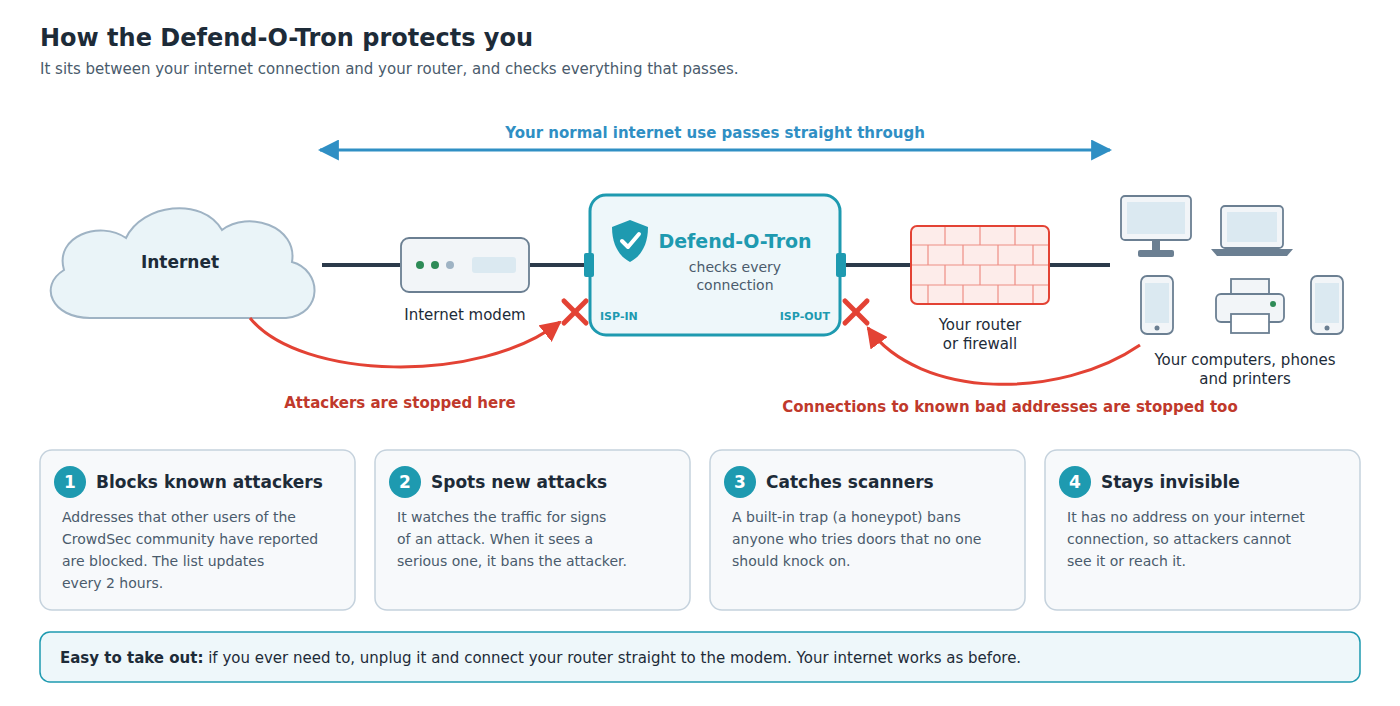
You manage the device through its separate management port, from a computer on your own network. See Installation Guide.
Want the architecture diagram, the list of defense components and a real port-scan test? They are on the Under the Hood pages.
¶ Getting Started
Your Defend-O-Tron is quick to install. You should be up and running in no time.
- Features Worry free defense.
- Requirements Networking and connections.
- Installation Guide Detailed installation instructions.
- First-Time Setup The Setup wizard, step by step.
- Use Cases Typical networking use cases.
- How It Compares Against traditional UTM security appliances.
¶ Threat Activity
What the Defend-O-Tron has seen, and what it did about it.
 Dashboard The totals, the global attack map and the top lists.
 Alerts What CrowdSec detected, by alert, source or attack session.
 Decisions The bans in force, ban and unban.
 History Decisions over 30, 90 or 365 days.
 Allowlists The addresses CrowdSec never bans.
- :satellite_antenna: Bouncers Connect other systems to the same bans.
 Metrics How CrowdSec itself is working.
¶ Detection
What the Defend-O-Tron looks for, and how it blocks.
 Rules The rule sets your site needs, and your own rules.
- Firewall Blocked, trusted and management lists.
 Honeypot How scanners are caught and banned.
 Honeypot Internals The rules, parser and scenario behind it.
- DNS Filtering The built-in AdGuard Home DNS filter.
- Audit Evidence The tamper-evident record, live.
- Log Ingress Send logs from your other systems.
¶ Administration
- Admin Interface Find your way around the web interface.
- Device Status Overview, services, monitoring.
- Compliance Reporting Generate tamper-evident NIS2 Article 21 audit evidence.
- Firmware Updates In-place firmware updates with rollback to previous or factory.
 Recovery and Reinstall Run a V100 from an SD card, or reinstall a V200 from a USB installer.
 Certificates Install the Defend-O-Tron Root CA on your workstation.
- :lifebuoy: Remote Support Open a temporary, operator-initiated support tunnel.
 Command-Line Tools do-stacks, awesome-o-image, defend-audit and tech-support.
¶ How-To Guides
Step-by-step guides for common jobs.
 Connect Another System to the Block List Give a router, firewall or web server its own key.
 Send Logs to the Defend-O-Tron Forward logs from your firewall, router and servers.
- Use the Defend-O-Tron for DNS Point your network, or just the protected.lan names, at it.
- Change the DNS Filter’s Password Replace AdGuard Home’s default password.
¶ Under the Hood
For the technically curious: how the Defend-O-Tron is built, the components that defend you, and the hardware underneath.
- Architecture Defense components and the protected-zone packet flow.
 Protection Test Real-world GRC Shields Up port-scan result.
- Hardware Spec What powers the Defend-O-Tron.
 Open Hardware Spec Schematics and more.
¶ About Awesome-O


Learn more about the company at awesome-o.ca.
 Donate Make a small donation or become a sponsor of this wonderful project!