¶ Current Models
Both models run the same firmware and web interface, and do the same job. The V200 has more processing power, memory and storage.
- V100 Compact and low-power, for small offices.
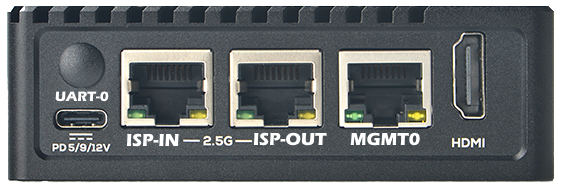
- V200 More headroom: x86, 16 GB, a 1 TB SSD and a TPM.
¶ Side by Side
| V100 | V200 | |
|---|---|---|
| Processor | Rockchip RK3568B2, 4× Cortex-A55 up to 2.0 GHz (ARM64) | Intel N150, 4 cores (x86-64) |
| Memory | 4 GB LPDDR4X | 16 GB DDR5-5600 (SO-DIMM) |
| Storage | 32 GB eMMC, plus an NVMe SSD (size varies) | 32 GB eMMC, plus a 1 TB NVMe SSD |
| Network | 1 GbE (MGMT0) and two 2.5 GbE (ISP-IN, ISP-OUT) | Four 2.5 GbE (MGMT0, ISP-IN, ISP-OUT and one not used) |
| Security chip | None | TPM 2.0 |
| Firmware | U-Boot | Dasharo (open-source coreboot with UEFI) |
| Local access | HDMI, and a serial console header | HDMI or DisplayPort |
| Power | USB-C Power Delivery (5, 9 or 12 V) | 12 V DC, 60 W adapter included |
| Metrics kept | 90 days | 180 days |
| Recovery | SD card and the MASK ROM button | USB installer |
| Open hardware | Board schematics published | Firmware open source; hardware design not |
See Recovery and Reinstall for the recovery steps.
¶ Power Supply
¶ V100
The V100 takes power over USB-C. It ships with a 5 V / 3 A USB-C adapter with an on/off switch:
| Model | RAS-PWR13-PI |
| Input | AC 100–240 V, 50–60 Hz |
| Output | DC 5 V, 3 A |
| Cable length | 47 in (1.2 m) |
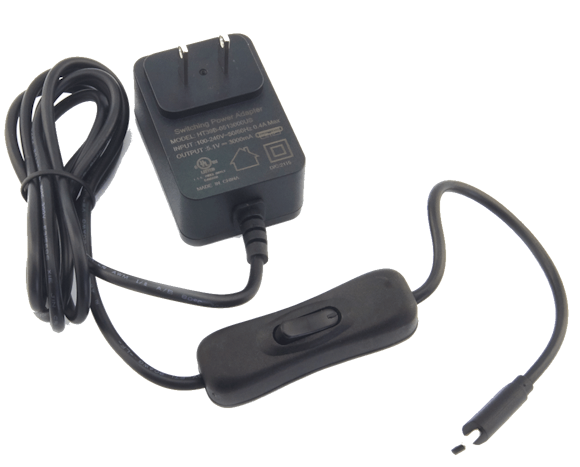
Any USB-C Power Delivery charger of 10 W or more also works.
¶ V200
The V200 ships with a 12 V DC, 60 W adapter. It draws at most 45 W (the maker’s figure).
Connect either model to a UPS, and never unplug it to turn it off. See Power and UPS.